Leave Your Message
Why Choose Cardboard Boxes for Global Shipping?
A Cardboard Box remains one of the most practical choices for international freight. It is lightweight, stackable, printable, and widely available near major logistics hubs. These qualities can reduce handling time and unnecessary transport weight. Small details matter. A reinforced corner can protect fragile goods during long warehouse transfers.
Industry data supports this preference. FEFCO, the European Federation of Corrugated Board Manufacturers, reports that corrugated packaging achieves recycling rates above 80% in Europe, although results differ between countries and collection systems. The U.S. Environmental Protection Agency has also identified paper and paperboard packaging as one of the most recovered material groups in municipal waste streams. Smithers’ global corrugated packaging research continues to show steady demand, driven by e-commerce, food distribution, and cross-border retail.
Protection is another important consideration. The right flute profile, board grade, and moisture-resistant treatment can help a box withstand compression and changing climates. However, cardboard is not automatically sustainable. Oversized packaging wastes material and increases shipping volume. Poor sealing can also invite moisture damage. That weakness deserves attention.
Export packaging professionals therefore assess product weight, stacking pressure, humidity, vibration, and destination handling conditions before selecting a box. Testing methods from the International Safe Transit Association, including compression and vibration testing, provide useful guidance. Real shipments still teach valuable lessons. A laboratory result cannot perfectly reproduce every port, truck, or rainy loading dock. Used thoughtfully, cardboard offers a credible balance of protection, cost efficiency, recyclability, and global availability.
Why Choose Cardboard Boxes for Global Shipping?
What Are Cardboard Boxes in Global Shipping?
In global shipping, cardboard boxes usually mean corrugated fiberboard containers. They contain flat liner sheets and a fluted inner layer. The flutes create cushioning and improve stacking strength. Box makers select different flute profiles for weight, distance, and handling conditions. A small parcel may need a single-wall box. Heavy machinery often requires double-wall construction.
These boxes are light, foldable, and efficient to store before use. Their rectangular shape also fits pallets, containers, and warehouse shelves. The FAO’s Global Forest Products Facts and Figures 2022 reported more than 400 million tonnes of paper and paperboard production worldwide. That scale shows the material’s importance in modern logistics. However, production volume does not guarantee responsible packaging. Oversized boxes still waste space and increase transport emissions.
A reliable shipping box needs more than thick walls. Testing should examine compression, stacking, vibration, and moisture exposure. ISO 12048 provides methods for testing filled transport packages under compression. In practice, humidity can soften corrugated board during ocean transport. Inner voids can also let products shift inside the box. Not glamorous. Still important.
I have seen packaging plans fail because they measured product weight, but ignored travel conditions. A better specification includes box dimensions, load distribution, closure method, and climate risk. Recycled fibers may reduce material impacts, yet they can require careful strength testing. Cardboard is practical, but it is not invincible.
| Data Dimension | What It Means | Typical Information or Range | Global Shipping Relevance | Practical Assessment |
|---|---|---|---|---|
| Basic Definition | A cardboard shipping box is generally a container made from paper-based board. Transport cartons are commonly made from corrugated fiberboard, which has one or more fluted paper layers between liner sheets. | Single-wall, double-wall, and triple-wall constructions are widely used. | Different wall constructions allow packaging strength to be matched with product weight, handling conditions, and shipping distance. | Versatile |
| Material Composition | Corrugated board is produced from kraft or recycled paper liners and a fluted medium bonded between the liners. | Common board grades include recycled, kraft-based, or mixed-fiber compositions. | Paper-based materials are broadly available in international markets and can be converted into many box sizes. | Widely available |
| Structural Protection | The fluted layer helps absorb impact and creates separation between the outer surfaces of the package. | Protection depends on flute profile, board grade, box dimensions, closure method, and product fit. | Properly specified corrugated packaging can help reduce crushing, abrasion, and movement during road, sea, rail, and air transport. | Good protection when correctly specified |
| Weight Efficiency | Corrugated boxes provide structural rigidity without the mass of many rigid packaging materials. | Actual box weight varies according to board grade, dimensions, wall construction, and moisture content. | Lower packaging mass can support efficient cargo planning and may reduce handling effort and transport-related emissions. | Lightweight option |
| Space Efficiency | Most corrugated cartons can be shipped and stored flat before use. | Flat-packed boxes generally occupy much less volume than assembled boxes. | Flat storage improves warehouse utilization and allows exporters, distributors, and fulfillment centers to assemble cartons when needed. | Space-saving |
| Customization | Boxes can be produced in different footprints, heights, wall strengths, internal partitions, and die-cut shapes. | Common configurations include regular slotted cartons, full-overlap cartons, die-cut cartons, and specialty inserts. | Custom dimensions can improve product fit, reduce void space, and support safer palletization or container loading. | Highly adaptable |
| Moisture Sensitivity | Paper-based board can lose strength when exposed to water, high humidity, or prolonged condensation. | Performance depends on coating, liner type, storage conditions, and exposure duration. | For ocean freight, humid climates, or temperature changes, exporters may need moisture-resistant treatments, liners, desiccants, or an additional outer barrier. | Requires planning |
| Stacking Performance | Box compression strength is affected by board quality, box geometry, load distribution, stacking alignment, and warehouse conditions. | There is no single universal stacking capacity; testing and specification are required for each package design. | Correct stacking design helps prevent carton collapse during pallet storage, truck transport, and container shipment. | Design-dependent |
| Recyclability | Clean corrugated fiberboard is commonly accepted in paper recycling systems, subject to local collection and processing rules. | Recyclability can be reduced by excessive contamination, wet conditions, or inseparable non-paper components. | Paper-based packaging can support waste-reduction goals, but exporters should verify destination-country recycling practices and labeling requirements. | Generally recyclable |
| Reuse Potential | A box may be reused when it remains dry, clean, structurally sound, and suitable for the next shipment. | Reuse depends on previous compression, punctures, creasing, moisture exposure, and closure damage. | Reuse can reduce packaging consumption, although boxes used for regulated or sensitive goods may require stricter quality control. | Condition-dependent |
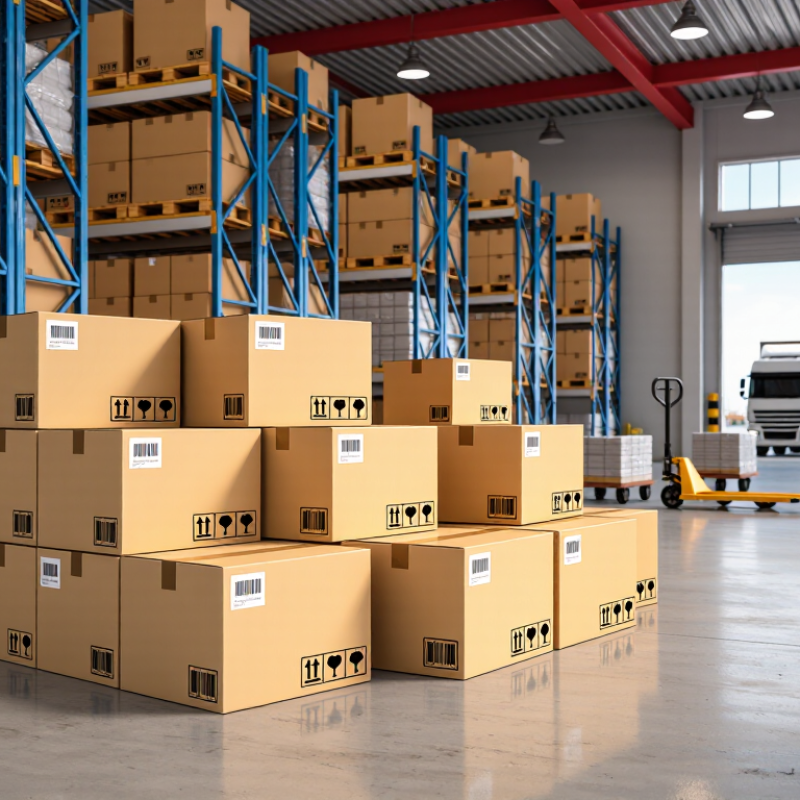
| Printing and Identification | Corrugated cartons can carry handling marks, product information, barcodes, shipping labels, and regulatory symbols. | Printing may be applied directly to the board or added through labels and stickers. | Clear package identification supports warehouse processing, customs documentation, carrier handling, and destination delivery. | Easy to identify |
| International Compliance | Packaging must meet the rules applicable to the product, transport mode, destination, and customs process. | Requirements may involve labeling, dangerous-goods packaging, phytosanitary controls for solid wood, and import documentation. | Cardboard boxes are often easier to standardize internationally, but packaging alone does not guarantee compliance for every shipment. | Check destination rules |
| Handling and Palletization | Cartons can be arranged on pallets, secured with stretch wrap or straps, and moved using standard material-handling equipment. | Load stability depends on carton dimensions, pallet pattern, weight distribution, and securing method. | Consistent box sizes can improve pallet utilization and reduce shifting during multimodal transport. | Logistics-friendly |
| Cost Factors | Packaging cost is influenced by paper prices, board grade, box dimensions, printing, tooling, order volume, and delivery distance. | Standard sizes and repeat production typically simplify manufacturing and procurement. | Flat-pack storage, broad material availability, and scalable production can make corrugated boxes practical for cross-border distribution. | Cost-efficient in many applications |
| Best-Suited Products | Corrugated boxes are commonly used for non-liquid goods that need protection from impact, compression, dust, and handling. | Examples include clothing, household goods, books, spare parts, packaged food, and many consumer products. | Fragile, high-value, temperature-sensitive, or hazardous products may require cushioning, liners, inner packs, or specialized certified packaging. | Product-specific |
Note: Actual packaging performance depends on board specifications, box design, product weight, environmental conditions, transport hazards, and destination-country requirements. Packaging should be tested and validated for the intended shipping route.